

Always Here for Advice
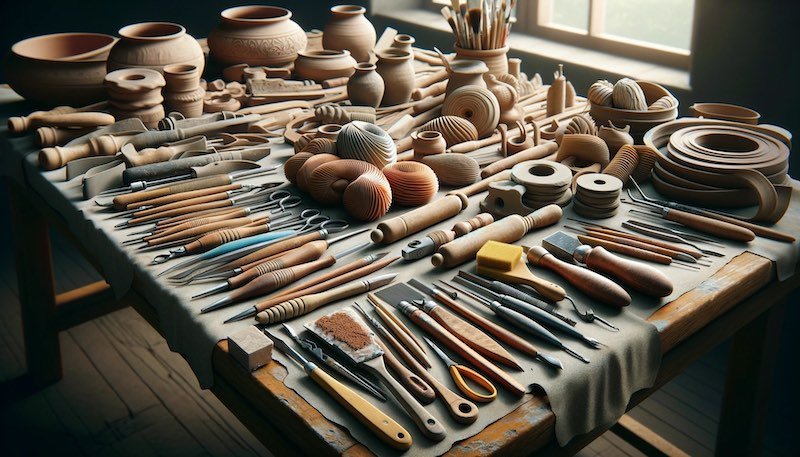
Choosing your first pottery tools is one of the earliest decisions you make, and the right handful genuinely changes how the work feels. Whether you are hand-building at the kitchen table, sculpting or throwing on the wheel, a well-chosen set makes shaping, trimming and finishing easier and more predictable. This 2026 guide covers the tools worth owning, what each one actually does, what to pay, and what to buy first.
The best pottery tools for a beginner are a needle tool, a metal rib, a wooden or rubber rib, a wire clay cutter, a trimming loop and a sponge. Those six cover scoring, shaping, cutting, trimming and smoothing. A complete beginner kit cost about £10 on Google Shopping UK in September 2026.
Almost every beginner project can be made with the six tools below. Buy these, use them for a few months, and let your own habits tell you what to add. The prices are what we counted on Google Shopping UK on 16 September 2026 across 95 listings — they move, but the shape of the market does not.
| Tool | What it does | What to look for | Typical UK price |
|---|---|---|---|
| Needle tool | Scores joins, trims a wobbly rim level, checks wall thickness | Stainless needle, firmly set in the handle so it cannot twist | £2–£5 |
| Metal rib | Compresses and refines curves on thrown walls | Stainless steel, thin enough to flex slightly against the clay | £3–£8 |
| Wooden or rubber rib | Smooths surfaces and presses in soft impressions | Sealed wood that will not splinter, or a soft rubber rib for finishing | £3–£10 |
| Wire clay cutter | Cuts clay off the block and lifts finished pots off the wheel head | A sturdier wire gauge — thin wires stretch and snap | £1.50–£5 |
| Trimming loop | Turns a foot and takes weight out of a leather-hard base | A stiff loop that does not bend under pressure | £4–£12 |
| Sponge | Wets the clay, lifts water from inside a pot, smooths as you go | A fine natural or dense synthetic sponge, not a washing-up sponge | £3–£14 |
Bought as a set, those six usually arrive together in an 8 to 14-piece kit. Of the 95 listings we counted, 83% were under £20 and the middle price was £10.80. A multi-piece kit sat at about £10. The most expensive single item on the whole page was a four-piece carving set at £108.61, and it is not a beginner purchase.
One honest caveat: cheap multi-packs pad the count with tools you will never use. A 45-piece set is usually six useful tools and thirty-nine shapes for polymer clay. If you can, buy the six above individually from a pottery retailer rather than a 50-piece bargain kit — you will spend about the same and end up with better steel.
We should be straight with you: we do not make hand tools. Kiln Crafts makes the big equipment — wheels, kilns, clay rollers, wedging benches — and the cheapest thing we sell that anyone would call a tool is £39. If you came here for a needle tool and a rib, we are the wrong shop, and we would rather say so than sell you something you did not come for.
Hand tools come from three kinds of seller, and the difference matters more than the brand name on the handle. Specialist pottery retailers stock the named ceramics brands, know what a rib is for, and will answer the phone — that is where to buy the tools you use every session. General craft shops carry serviceable starter kits at low prices and are fine for the tools you use occasionally. The big marketplaces are cheapest of all and carry everything, with the caveat that the steel quality is a lottery and the listings are written by people who have never thrown a pot.
What we can help with is everything the tools are used on. That is the rest of this guide.
Once the six essentials are familiar, these are the ones worth adding — but add them because a job is annoying you, not because a set has a gap.
The tools that matter depend far more on your technique than on your skill level.
New potters often ask which brand to buy. The reassuring answer is that you do not need the most expensive name on the shelf. Build quality, material and fitness for the job matter far more than the badge. Judge any brand on these four things.
For most potters, spending a little more on the two or three tools you reach for every session gives the best return, while occasional-use tools can be basic without it costing you anything.
There is a second kind of tool, and it is the kind we do make. These are the ones that stop a job being the reason you put the clay down — rolling slabs by hand, wedging until your wrists ache, throwing on a board that slides. They cost more than a rib, and they last decades.
And if you are reading a tools guide because you are thinking about throwing at all, the honest first purchase is the wheel, not the kit — the tools cost a tenth of what the wheel does. Our pottery wheels start at £1,199, and most are built to order. The accessories collection has the aprons, batts and shelves in one place.
The best pottery tools for a beginner are a needle tool, a metal rib, a wooden or rubber rib, a wire clay cutter, a trimming loop and a sponge. Those six cover scoring, shaping, cutting, trimming and smoothing. A complete beginner kit cost about £10 on Google Shopping UK in September 2026.
For your first kit, a needle tool, a metal and wooden rib, a wire cutting tool, a trimming loop and a sponge will cover almost every beginner project. These five potter's tools handle scoring, shaping, cutting, trimming and smoothing across hand-building and wheel throwing.
A potter's rib is used to shape, compress and smooth clay. Metal ribs are firmer and great for refining curves and compressing the walls of thrown pots, while wooden ribs give a softer finish and are ideal for smoothing and adding subtle impressions.
Both remove clay, but loop tools have a closed wire loop best for trimming and carving firmer clay, while ribbon tools have an open ribbon-shaped head that shaves clay away cleanly, which is better for sculpting and removing larger amounts during shaping.
Not much. Of the 95 pottery tool listings we counted on Google Shopping UK on 16 September 2026, 83% were under £20 and the middle price was £10.80. Spend a little more on the two or three tools you reach for every session and buy the rest cheaply.
Clean them after every session to stop clay drying on, dry metal tools thoroughly to prevent rust, store them somewhere dry and organised, and replace worn wires or blunt blades when they stop cutting cleanly.
Start with the six. Add what the work asks for. Keep making.
This wheel package comes with a kiln
We've taken the wheel package out of your cart. That price is only for people buying a kiln at the same time — pick your kiln and you can add the package back on the kiln's page.